The first industrial project in Caesar II is where most freshers understand that piping stress analysis is not just software work. In training models, everything looks simple and controlled. But actual projects are different. Pipe routing changes often. Supports the move. Temperatures vary. Equipment loads become critical. One small mistake inside the model can affect the entire piping line. This is why proper Caesar 2 Training matters for fresh engineers entering oil and gas, refinery, and power plant projects.
Wrong Support Placement
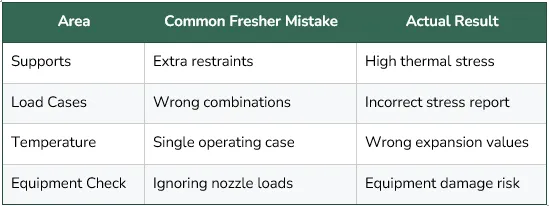
One mistake almost every fresher makes is adding too many supports. At first, it feels like more support will make the pipe stronger. But in stress analysis, wrong supports create more problems.
Pipes need movement when temperature increases. If supports block that movement, stress starts building inside the line. This stress finally reaches pumps, exchangers, and valves.
Freshers usually:
● Place anchors unnecessarily
● Lock movement in every direction
● Ignore support gaps
● Forget to check support loads
This creates high nozzle loads and unrealistic stress values. In actual projects, support location matters more than support quantity.
Area
 Common Fresher Mistake Actual Result
Problems with Load Cases
Another common issue is load case preparation. Many freshers copy old project files and use the same load combinations without checking the project condition.
Caesar II mainly works with sustained loads, thermal loads, and occasional loads. Each load case behaves differently.
If thermal loads are mixed incorrectly with sustained loads, the stress report becomes misleading. The software may show acceptable values while the actual piping condition remains unsafe.
Good Caesar ii Certification programs now focus more on load understanding because industries need engineers who can read stress behavior properly, not just generate reports.
Poor Thermal Expansion Understanding
Thermal expansion creates many hidden problems in piping systems. When temperature increases, pipes expand in length. Freshers usually underestimate this movement.
Many beginners use only one temperature condition for the complete line. But real plants operate under multiple conditions like startup, shutdown, steam flushing, and normal operation.
Because of wrong temperature handling:
● Pipe displacement increases
● Supports may fail
● Connected equipment receives extra force
● Flange leakage can happen
Understanding thermal growth is one of the most important parts of stress analysis.
Incorrect Restraint Directions
Freshers often apply restraints without understanding movement direction. They simply block movement in all axes to reduce displacement.
But this creates another issue. When movement gets blocked unnecessarily, flexibility reduces. Stress automatically increases.
For example:
● Guides control sideways movement
● Line stops control axial movement
● Anchors stop all movement
Using these restraints without understanding pipe behavior creates unrealistic results.
Many fresh engineers now also learn E3D Online Training because plant routing and stress analysis work closely together in modern projects.
Ignoring Equipment Safety
Another common mistake is checking only code stress values. Freshers often forget that connected equipment also has allowable load limits.
Industrial projects always verify the following:
● Nozzle forces
● Nozzle moments
● Equipment allowable values
Ignoring these checks can create vibration and alignment problems during startup.
Blind Trust in Software
Many freshers trust software output too much. If Caesar II gives a green result, they assume the line is safe.
But the software only calculates based on the model created by the engineer. If the model is wrong, the output will also be wrong.
Real plants contain many practical conditions that software cannot predict automatically:
● Structural movement
● Fabrication tolerances
● Support gaps
● Field misalignment
Experienced engineers always compare software results with practical piping behavior.
Proper Caesar 2 training teaches engineers how to validate results instead of depending completely on automatic calculations.
Conclusion
Industrial piping projects require more than software knowledge. Stress analysis becomes easier only when engineers understand how pipes actually behave inside a running plant. Good Caesar II certification helps freshers understand support logic, thermal movement, restraint behavior, and load distribution in a practical way.
Today, companies expect stress engineers to work closely with piping designers and 3D model teams. Because of this, learning tools like E3D Online Training is also helping fresh engineers understand routing problems before stress analysis starts.